The short answer: it depends on who does the work
A dumpster rental and a junk removal job aren't priced the same way, so compare what each one includes, not just the first number you hear. Here's when each one tends to cost less:
- A dumpster: a renovation or project that runs for weeks, you have the help and the time to load it yourself, there's a driveway to park it on, and the debris is the kind the rental company accepts.
- Junk removal: a one-day house, garage or basement cleanout, heavy pieces upstairs or in the basement, a tight or shared driveway, or a deadline like a closing or a move-out date.
- Either way: hazardous waste like oil-based paint, solvents, chemicals, gas cans and motor oil can't go in a dumpster or a junk truck, and some everyday items, like TVs and old fridges, need special handling (see below).
What a dumpster rental actually covers
A dumpster quote usually covers the container, a set number of rental days and a weight allowance. Rental companies set their own weight allowances, and no town or county publishes a standard one, so read the quote for what happens if the load comes in heavy or the rental runs long.
Weight matters because disposal is charged by weight. Monmouth County's Reclamation Center charges every load on its actual tonnage, recorded on scales in 20-pound steps, and Burlington County prices disposal per ton or per 100 pounds. Tile, plaster, dirt and concrete use up a weight allowance much faster than furniture and boxes do.
What stays on you with a dumpster:
- The loading. Every couch, dresser, box and bag goes up and over the side by hand, yours or your helpers'.
- The driveway. The container sits there for the whole rental.
- The permit, if your town requires one. Some towns want one even in your own driveway (rules by town below). Ask the rental company whether it handles the permit or you do.
- The leftovers. Anything the rental company refuses still has to go somewhere else.
What junk removal covers
A junk removal price covers the labor, the carrying, the loading and the disposal in one number. The crew carries everything out from wherever it sits, attics, basements and upstairs bedrooms included, so you don't lift anything, and nothing sits in the driveway overnight.
Check the license. Monmouth County's Reclamation Center rules say anyone hauling other people's waste needs an NJDEP license. New Jersey Junk Removal holds A-901 license #0042737, and every load is handled as waste under it: scrap metal is recycled when possible, tires, electronics and concrete go to licensed recyclers, and the rest goes to licensed transfer stations and landfills. Nothing is donated, so set aside anything you plan to give away before cleanout day.
Some towns send cleanouts to a dumpster or private hauler
Curbside bulk pickup isn't built for a whole house, and several Central NJ towns say so on their own pages:
- Hamilton takes up to three bulk items at the curb and doesn't pick up contractor work. For home, garage and basement cleanouts, it tells residents to make other arrangements, like a dumpster or a dumpster bag.
- Mount Holly says move-outs, residential cleanouts and construction material call for a dumpster scheduled with the Construction/Housing Department, with the paperwork done before delivery. Large piles at the curb won't be picked up and can bring fines.
- Florence says that for a home cleanout you must make your own arrangements for disposal, such as a dumpster. If that can't be done before settlement, it urges sellers to ask for money to be held in escrow to cover disposal.
- Bordentown Township tells residents to use dumpsters for renovation projects, and permits are required.
- Toms River doesn't pick up move-outs or an excessive volume, and tells residents to contact a private removal service. Small amounts of construction and demolition debris can go to its Recycling Convenience Center in containers, and larger amounts go to an approved landfill.
Do you need a dumpster permit? Rules by town
State law comes first. Under N.J.S.A. 27:5I-1, nobody may park or leave a roll-off container on or along a highway or other public property without written consent from the town, county or state authority over that road, and the container needs yellow reflective diamond panels, at least 18 by 18 inches, on both ends. NJDEP's guidance says that rule applies only to containers on roadways or public property.
Town codes add their own rules on top, and a few require a permit even on private property. Here's what the online codes say for towns in our area:
- Robbinsville: permit needed even in your driveway, from the Construction Official, with proof of liability insurance, unless an approved site plan covers it. Street permits last 14 days, driveway permits 30, with one renewal. A street container must sit in a legal parking space and have reflectors.
- Mount Holly: permit needed even in your driveway, from the Township Clerk's office, with proof of insurance. Street permits last 14 days and driveway permits 30, renewable up to three times.
- Bordentown Township: permit needed anywhere, driveway or street, from Community Development before the dumpster arrives. It's good for up to 30 days, with extensions up to 90.
- Lawrence: no driveway permit found; a street dumpster needs an Engineering permit, only when there's no off-street spot, and must go within 72 hours. It sits at the edge of the road and can't go where parking is banned.
- Freehold Township: no driveway permit found; a street dumpster needs a Police Department permit, issued only while the driveway apron is being rebuilt and can't hold it, for 2 days at most, with reflective panels.
- Marlboro: no driveway permit found; a street dumpster needs a permit from the Police Bureau of Traffic and Safety, good for 14 days and renewable in 14-day periods, with reflective panels.
- Florence: no driveway permit found; a curbside dumpster is allowed only when there's no driveway or other approved off-street spot, with police approval. Apply at least 3 business days before delivery; it can stay up to 30 days, with renewals.
- Hamilton and West Windsor: no driveway permit, since their codes cover only the street and right-of-way; a roll-off on the street needs police authorization, and police can remove a container and bill the owner.
- Princeton: no driveway permit found, and on construction sites the dumpster goes in the driveway whenever possible. A curbside one needs a right-of-way permit good for 10 days, with at most two renewals, and none are allowed on the street from December 1 to March 31 or within 50 feet of an intersection. Planks go under the wheels, street dumpsters are tarped at night, and the container can't arrive more than 2 business days before work starts.
- Jackson: permit needed even on a home lot for construction containers (containers for construction waste or debris), from the Zoning Officer, good for up to 180 days. A front-yard container sits at least 10 feet from the property line, one on the street needs a development permit good for 45 days, and a home can have no more than 2. Ask the township whether a cleanout-only dumpster counts.
- Colts Neck: never on the street, since no dumpster is allowed in the public right-of-way. A temporary one tied to an active construction permit can sit in the front yard.
If your town isn't listed
Call the township before delivery day. We found no dumpster placement-permit section in the online codes for Toms River, Brick, Howell, Millstone, Wall or Lakewood, but that doesn't mean no permit is needed. On a public street, the state's written-consent and reflector rule applies everywhere.
Renovation dumpsters: debris plans and covers
Several towns tie dumpsters to building and demolition permits. For projects that need a building or demolition permit and use a dumpster or roll-off, Plumsted Township (New Egypt), Howell, Berkeley (Bayville), Lakewood and Lakehurst require a debris recovery plan showing how at least 50% of the material will be separated and recycled. Princeton has the same 50% rule for permitted projects using a container of 10 cubic yards or more. These plans come with the building or demolition permit, so a plain cleanout with no permit isn't covered by them.
Toms River's, Howell's and Marlboro's stormwater codes say outdoor dumpsters must be covered at all times and must not leak, and permitted temporary demolition containers are an exception. Ask your township how that applies to a rental container that will sit for a while.
For what goes where on a renovation, see our construction debris disposal guide.
What can't go in a dumpster in NJ
Every rental company has its own list, so ask for it in writing. These are the rules behind most of those lists:
- Hazardous waste: oil-based paint, stains and thinner, chemicals, gas cans, motor oil, propane tanks and asbestos. Monmouth County's Reclamation Center turns away batteries and any liquid or hazardous material, which rules out wet latex paint too. Our paint, propane, tire and electronics guide shows where each one goes and how to dry out leftover latex.
- TVs and computers. New Jersey's E-Waste Law bans throwing away TVs, computers, monitors, laptops, desktop printers and desktop fax machines sold to consumers.
- Fridges, freezers and window air conditioners. They usually still hold refrigerant, and under EPA rules the last stop in the disposal chain, a scrap recycler or a landfill, has to make sure it's recovered, or keep a signed statement if the appliance arrived already empty. Monmouth's Reclamation Center turns away large metal appliances. Ask the rental company before you load one, and see our refrigerator and appliance disposal guide.
- Tires mixed into the load. Monmouth's Reclamation Center says tires may not be mixed with other materials, and it lists an additional surcharge for them.
- Leaves, grass and big limbs. Monmouth County's recycling guide says not to throw leaves or grass in the trash, and the Reclamation Center turns away leaves, plus stumps and limbs over 3 inches.
- Concrete, brick and asphalt. Monmouth County lists asphalt, brick and concrete, metal scrap, tree parts, and computers and TVs as mandated recyclables, and the Reclamation Center turns away concrete and asphalt.
How much fits in a 20-yard dumpster?
Dumpsters are sized in cubic yards, and common rental sizes run from about 10 to 40 yards. A cubic yard is a cube 3 feet on each side, or 27 cubic feet, so a 20-yard container holds 540 cubic feet filled level to the top.
How much of a house that covers depends on what's going in and how tightly it's packed. Bulky furniture leaves a lot of air in a container, and heavy debris can reach the weight allowance before the container looks full. If you're not sure what size you need, text photos to (855) 655-7552 and we'll price the job as a junk removal instead, so you have both numbers side by side.
Or we'll haul it for you
If it's a one-day cleanout, the heavy pieces are upstairs or in the basement, or there's no good spot for a container, text photos to (855) 655-7552. You'll get one upfront price that covers the carrying, loading, hauling and disposal, and the price we quote is the price you pay. Jobs have a $250 minimum, and nothing sits in your driveway or needs a street permit.
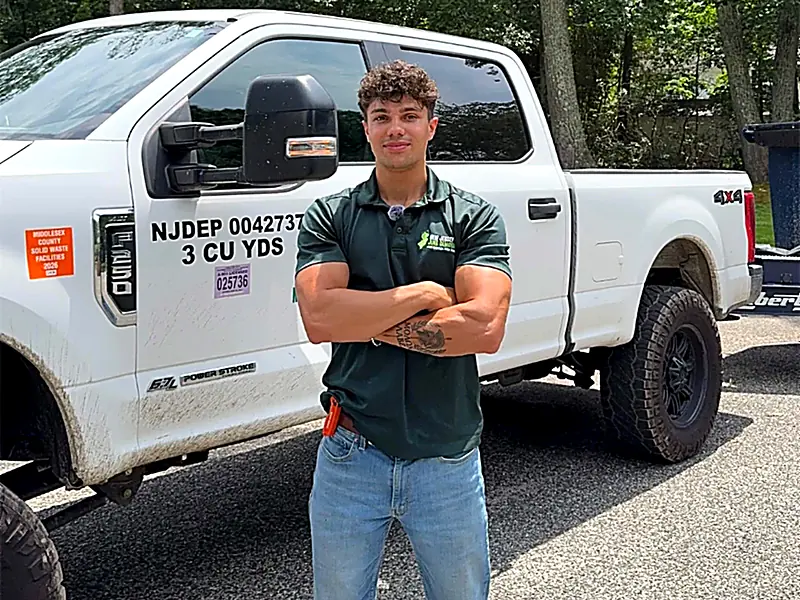
Dominic and his crew handle estate cleanouts, garage cleanouts, basement cleanouts, rental and eviction cleanouts, construction debris removal and appliance removal. We do the take-down work ourselves too, from sheds and decks to light demolition, then haul every piece away and sweep up. For a whole house, start with our estate cleanout checklist; if you only missed your bulk day, our missed bulk pickup guide covers the next pickup and the drop-off sites.
Same-day and next-day openings are often available across Monmouth, Ocean, Burlington, Mercer and Middlesex counties, from our base in New Egypt. We take everything, dried-out latex paint cans included, except hazardous materials like wet or oil-based paint, chemicals, gas cans, motor oil, propane tanks and asbestos, and medical waste. Rather meet in person first? Book a free estimate.