The short answer, county by county
Construction and demolition debris (C&D) is handled county by county in New Jersey, and every disposal site charges by weight. Here's where each county in our area points residents:
- Monmouth: the Monmouth County Reclamation Center in Tinton Falls takes C&D from county residents, charged by weight, but not in rented vehicles. No concrete or asphalt, though asphalt shingles are accepted.
- Ocean: the county lists the privately owned Ocean County Landfill on Route 70 in Manchester for bulky trash, and Toms River sends larger debris loads there. No fee is published, so call (732) 323-8528 before you go.
- Burlington: the county's Resource Recovery Complex in Florence takes C&D, charged by weight, but not in rented vehicles.
- Mercer: the Mercer County Improvement Authority's transfer station in Ewing takes Mercer County waste only, from users with a prepaid account, charged by weight.
- Middlesex: the county landfill takes only licensed haulers. Residents are pointed to their public works department, a licensed hauler, or a private transfer station that charges per load.
- Concrete, brick, block and asphalt: Monmouth's center turns them away and Burlington's rate list doesn't include concrete, so plan on a Class B recycling facility unless your town takes it.
Monmouth County: the Reclamation Center in Tinton Falls
The Monmouth County Reclamation Center is at 6000 Asbury Avenue in Tinton Falls, (732) 683-8686. Residents unload at the residents' tent, open Monday to Friday 7 a.m. to 3:30 p.m. and Saturday 7 a.m. to noon. It's closed Sundays, New Year's Day, Thanksgiving and Christmas, and closes at noon on Memorial Day, Independence Day and Labor Day. The center's FAQ says the construction and demolition debris it gets comes in mostly through the residents' tent, and the center's rules say it takes no solid waste from outside Monmouth County.
Construction debris is charged by the ton on actual weight, with no minimum; check the current rate on the center's fee page, linked in the sources below. Monmouth residents dumping their own household waste can pay cash or by personal check, and need a valid driver's license and the vehicle's current registration (and the trailer's, if there is one) at the scale. Everyone else needs a prepaid account.
Open loads must be tarped, and the county's recycling guide says police enforce it. Tires can't be mixed into a load without a surcharge. The center turns away concrete and asphalt (shingles are fine), stumps and limbs over 3 inches across beyond small carloads, liquids and hazardous materials, large metal appliances, car and household batteries, recyclables like newspaper, glass and food cans, leaves, and TVs and computers.
No dumping permit is needed for a car or truck rated 9,000 pounds or less (16,000 with a trailer) carrying your own waste. Hauling anyone else's waste, even in a small pickup, takes a state DEP permit that the landfill can't sell you, and anyone collecting other people's waste also needs the State Police A-901 investigation. Residents can't use rental vehicles or vehicles with commercial plates.
Ocean County: the landfill in Manchester and Class B recyclers
Ocean County lists the Ocean County Landfill at 2498 Route 70 in Manchester, (732) 323-8528, for bulky trash disposal. It's open Monday to Friday 7:30 a.m. to 3:30 p.m. and Saturday 7:30 a.m. to noon. The county notes that the landfill is privately owned and operated and isn't part of its Solid Waste department, and the county's solid waste plan directs waste that can't be recycled to that facility.
No official page lists the landfill's fees for residents. Manchester Township says only that the landfill will charge for any bulk items, so call before you go to ask whether it takes your load and what it costs.
Town programs cover only small amounts. Toms River doesn't pick up construction or demolition debris at the curb. Its Recycling Convenience Center takes up to two 35-gallon containers of it at a time, twice a month, and debris that isn't in containers is refused. Anything bigger goes to an approved landfill such as the Ocean County Landfill, brought by the resident, a contractor or a licensed trash hauler.
For concrete, asphalt and brick, the county sends residents to Class B recycling facilities and tells them to call each one to confirm which materials it's currently accepting. The county's page lists six Ocean County sites, five of them for concrete (the sixth takes only tires), and links the NJDEP's statewide list.
Burlington County: the Resource Recovery Complex
The Resource Recovery Complex is at 22000 Burlington-Columbus Road in Florence, (609) 499-5300, open Monday to Friday 7 a.m. to 5 p.m. and Saturday 7 a.m. to noon. It takes waste from all 40 Burlington County towns, and every driver fills out a Waste Origin and Disposal Form before entering.
Rental vehicles of any size are turned away. The county's 2025 brochure says that unless you're bringing waste from your own home in a passenger vehicle, the vehicle needs an NJDEP solid waste hauling decal. The same brochure lists payment by cash, business check, Visa, Mastercard or Discover (no personal checks), and closures on Sundays, New Year's Day, Memorial Day, July 4, Labor Day, Thanksgiving and Christmas.
Construction and demolition debris is charged by the ton, with a minimum charge on anything weighed; check the current rate on the county's Disposal Rates page, linked in the sources below. Sorting pays here: separated scrap metal is free, clean lumber costs far less than mixed or treated wood, and separated asphalt shingles cost less than mixed debris. Tires, appliances, TVs, propane tanks and car batteries found in a dumped load bring a surcharge for each one.
Concrete isn't on the county's rate list, and the NJDEP's Class B list doesn't show the complex as a concrete site. It shows three other Burlington County facilities that take concrete.
Mercer County: MCIA accounts and Hamilton's rules
Mercer County's solid waste program works through the Mercer County Improvement Authority (MCIA), whose transfer station is at Dover and Stokes Avenues in Ewing, entered from North Olden Avenue. Everything dumped there must come from Mercer County, and every user needs a prepaid MCIA account, opened at 80 Hamilton Avenue in Trenton, (609) 278-8100. Opening an account takes a prepaid deposit by check or money order. Cash isn't taken at the scale. Each load needs a Waste Origin and Disposal Form, and vehicles must be NJDEP-registered unless they're exempt light vehicles (the MCIA's own pages put the cutoff at 8,000 pounds in one place and 9,000 in another, so ask when you call).
Bulky waste and C&D are charged by the ton; the MCIA's 2026 tip-fee notice, linked in the sources below, has the current rate. No official page describes a separate drop-off for residents without an account, so call the account office before you load up.
Hamilton adds its own rules. Concrete and blacktop aren't accepted at the Ecological Facility on Kuser Road or at the curb, and the township tells residents to hire a disposal contractor that takes concrete. Debris from work done by contractors, like fencing or wood, isn't collected. Wood from your own projects, including doors, paneling and plywood, goes out as bulk once it's cut to 4 feet, bundled and stripped of nails.
Middlesex County: private transfer stations
The Middlesex County landfill is open only to licensed solid waste haulers and can't take loads from residential vehicles without NJDEP permits. For bulky waste, the county tells residents to call their public works department, hire a licensed hauler, or use a private transfer station.
The county's disposal page lists private transfer stations that accept personal vehicles under 9,000 pounds (16,000 with a trailer) and charge per load. Call first for days, hours and fees. The county Solid Waste office in Piscataway takes questions at (732) 745-4170. In Old Bridge and the other Middlesex towns, your public works department is the first call.
Concrete, brick, block and asphalt
Concrete, brick, block and asphalt go to Class B recycling facilities, which the NJDEP approves. Under the NJDEP's rules, any company that accepts recyclable concrete and asphalt from outside contractors is operating a Class B recycling center. The state's July 2026 list, sorted by county, codes each site by material: A for asphalt, BB for brick and block, C for concrete, AS for asphalt shingles, GY for gypsum (drywall) and W for wood. It shows 10 concrete sites in Monmouth County, 7 in Middlesex, 5 in Ocean, 4 in Mercer and 3 in Burlington.
County and town rules send concrete there too. Monmouth's Reclamation Center refuses concrete and asphalt, and the county's recycling guide sends residents to a private Class B facility, where you pay and should call ahead to confirm prices and hours. Jackson's Transfer Station is an exception for Jackson residents: it takes concrete and cinder blocks without a voucher, with any rebar pulled out and dropped off separately. Hamilton won't take concrete or blacktop, Lakewood tells residents to find a vendor for concrete, bricks and cinder blocks, and Freehold Township's bulk pickup excludes concrete.
The NJDEP recommends contacting any facility beforehand, because accepted materials, fees and hours vary from site to site. Ask whether the site wants concrete kept separate from the rest of the debris.
Drywall, wood and what your town takes
Drywall, lumber and other remodeling leftovers are where town programs differ most. Most limit what they take to small amounts from work you did yourself:
- Jackson's Transfer Station on Don Connor Boulevard, open Friday to Tuesday 8 a.m. to 3:45 p.m. for Jackson residents only, takes construction debris with a voucher: up to two per residential lot a year, pieces no bigger than 4 by 4 feet, from work the homeowner did personally. Contractor debris, rentals, commercial plates and house cleanouts are turned away. Concrete and cinder blocks don't need a voucher.
- Brick takes no construction materials of any kind at its Recycling Center on Ridge Road, and they can't go in the automated trash cans.
- Lakewood doesn't pick up construction and demolition material at the curb.
- Freehold Township's bulk pickup excludes building materials, construction trash, concrete and anything over 200 pounds.
- The Plumsted MUA's monthly bulk pickup in New Egypt takes drywall and building material from remodeling done by the resident or owner, within limits: 4 by 4 by 4 feet overall, wood cut under 4 feet with sharp nails or screws removed or bent flat, and containers of 50 pounds or less, 100 pounds per collection.
- Monmouth County's recycling guide sends sheetrock and treated or painted wood to town programs that take it, private bulk facilities, or the Reclamation Center, where you pay. Clean, untreated wood can go to some towns, private facilities or the Reclamation Center.
Before you load the truck yourself
A few checks save a wasted trip to the scale:
- Call the site first. The NJDEP recommends it, because accepted materials, fees and hours change.
- Haul only your own debris. At Monmouth's center, hauling anyone else's waste takes a state DEP permit, and Jackson's voucher covers only work the homeowner did.
- Leave the rental truck out of it. Monmouth's Reclamation Center and Burlington's complex both refuse rented vehicles, and Jackson's Transfer Station doesn't take rentals either.
- Tarp the load. Monmouth requires it on every open load.
- Sort as you load. Concrete and masonry go to a Class B site, separated scrap metal and wood cost less or nothing in Burlington, and tires, appliances and TVs mixed into a load bring surcharges or get the load turned away.
- Bring the paperwork: a Waste Origin and Disposal Form in Burlington and Mercer, a prepaid account in Mercer, and your driver's license and vehicle registration in Monmouth.
- Pull out wet or oil-based paint, solvents and anything that might be asbestos; latex cans that have dried solid can stay in the pile. Disposal sites turn away liquids and hazardous materials, and our guide to what junk removal can't take lists where each one goes.
When it's easier to have us haul it
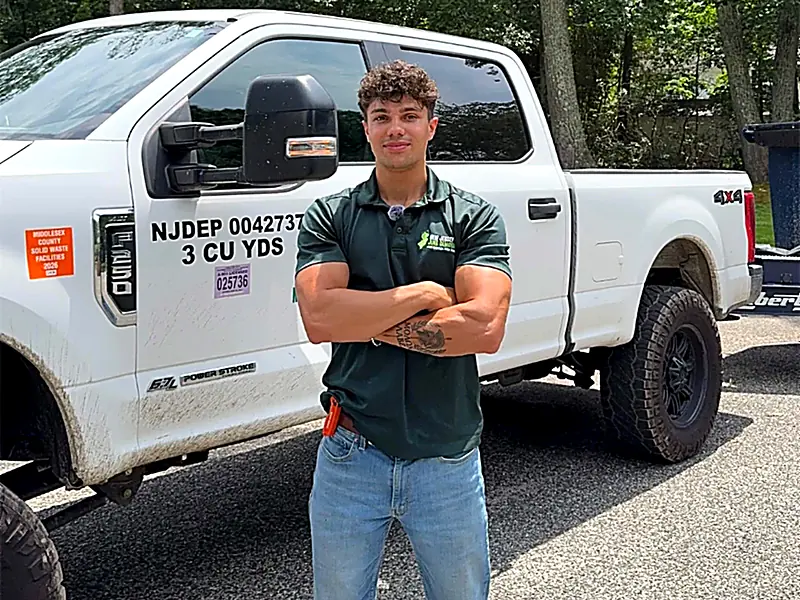
Between the tarps, the scale-house forms, the rental-truck bans and a separate trip for the concrete, a weekend tear-out can turn into a second weekend of hauling. We load renovation debris from wherever it sits, whether that's the garage, the basement, the side yard or an upstairs room: drywall, lumber, shingles, cabinets, flooring, concrete, brick and block. Nothing needs to be cut down, bundled or carried to the curb first. Dominic works jobs himself alongside his crew, and we sweep up before we leave.
Still standing? We do the take-down work too, from decks and sheds to light demolition, then haul every piece away. Dirt and rock piles fall under yard debris removal. Everything we haul is handled as waste under our NJDEP A-901 license: scrap metal is recycled when possible, tires, electronics and concrete go to licensed recyclers, and the rest goes to licensed transfer stations and landfills.
Text a photo to (855) 655-7552 for one upfront price. Jobs have a $250 minimum, and same-day and next-day openings are often available. See construction debris removal for how a pickup works, or our couch and furniture guide if the rest of the pile is furniture.
Services for this job
- Construction & Renovation Debris
- Light Demolition & Interior Demo
- Deck Removal
- Yard Debris & Rock Removal