Step 1: Confirm who can make decisions
In New Jersey, the executor named in the will applies to the Surrogate's Court in the county where the person lived. Monmouth County's Surrogate asks for the original will and any codicils, a death certificate with a raised seal, the names and addresses of next of kin, and a photo ID. Once the will is accepted, the Surrogate issues Letters Testamentary, which give the executor authority to administer the estate. They can't be issued before the eleventh day after death.
With no will, the process is called administration, and the Surrogate grants letters of administration instead. A bond may be required. Ocean County's Surrogate is at 118 Washington Street in Toms River, and Monmouth County's is at the Hall of Records in Freehold.
Until someone has that authority, hold off on selling or giving away anything of value. If family members disagree about what happens to the house or its contents, bring in the estate's attorney before anything leaves.
Step 2: Secure the house
- Collect every key, garage remote and lockbox code. Change the locks if keys are unaccounted for.
- Keep the power, heat and water on until the cleanout is done. Everyone working in the house needs lights, and an unheated house can have frozen pipes by January.
- Call the homeowner's insurance company and ask whether coverage changes while the house sits empty.
- Photograph every room before anything moves. It helps with the inventory and settles questions later.
- Have the mail held or redirected so statements and bills don't pile up at an empty house.
Step 3: Search before you sort
Paperwork and valuables hide in odd places in a lifetime of belongings. Go through the whole house before anyone starts filling bags, and collect what you find in labeled boxes. Look for:
- The original will, trust papers, deeds, vehicle titles and recent tax returns
- Bank, brokerage, pension and insurance statements, plus any safe deposit box key
- Cash, jewelry and coins tucked into drawers, coat pockets, books, shoeboxes and freezers
- Photos, letters, military records and other family keepsakes
- Phones, computers and written passwords that may hold accounts or photos the family wants
Step 4: Decide what stays, sells and goes
Give family members a firm date to claim what they want. Then mark keep items with colored tape, or better, gather them in one room that stays closed during the cleanout. One clearly labeled room is easier to work around than notes stuck on single pieces.
If you're holding an estate sale or selling furniture, finish that first. Donations come next, then whatever is left. Working in that order means nothing worth keeping ends up on a truck by mistake.
Step 5: Handle what a cleanout crew can't take
Leftover medications go to a Project Medicine Drop box. The program, run by the New Jersey Division of Consumer Affairs, puts secure drop boxes inside participating police department headquarters, and you can use them anonymously any day of the year. Hamilton Township's guide notes the boxes take pills, patches and inhalers but not syringes or liquids.
Needles and lancets used at home go into a rigid plastic bottle with a screw cap, such as a detergent or bleach bottle. Tape the cap, label it, and put it in the trash, never the recycling. That's the guidance from Monmouth County and Hamilton Township, and some hospitals take sharps too.
Old paint, cleaners, pesticides, motor oil and propane tanks go to your county's household hazardous waste program. Our guide to what junk removal can't take in NJ lists where each one goes, county by county. If you find ammunition or fireworks, Monmouth County's guide says to call the local police department.
Step 6: Shred the old paperwork
Once the executor has what they need, shred the rest of the old statements and records instead of bagging them. County programs make it easy:
- Monmouth County runs free paper shredding events for county residents, hosted by different towns around the county. Every event is open to any Monmouth County resident, not just the host town.
- Ocean County runs a free Residential Document Shredding Program with events each spring and fall, plus drop-off bins for paper you've already shredded at its recycling centers in Lakewood and Manahawkin.
- Middlesex County holds residential paper shredding events for personal papers only. Business documents are turned away.
- Burlington County takes already-shredded paper, bagged in clear plastic, at the convenience center at its Resource Recovery Complex.
- In Mercer County, Hamilton Township's guide points residents to the county improvement authority's shredding and hazardous waste events.
Step 7: Wipe and recycle the electronics
New Jersey law keeps TVs and computers out of the trash, so they have to be recycled. Before any of them leave the house, back up family photos and wipe or pull the hard drives, and factory-reset old phones and tablets.
New Jersey residents can recycle TVs, computers, monitors, laptops, desktop printers and fax machines free at the manufacturer collection sites the NJDEP lists. As part of a cleanout, we take electronics to licensed recyclers ourselves.
Step 8: Clear the house, top to bottom
Work from the top floor down and finish with the basement, garage and shed, so nothing gets carried back through rooms that are already empty. Leave the refrigerator for last if people are still using the house. If you're handling it yourself, our guide to getting rid of an old refrigerator in NJ covers the refrigerant rules. An old shed, deck, hot tub or playset in the yard can come down as part of the same job.
When it's easier to have us clear it
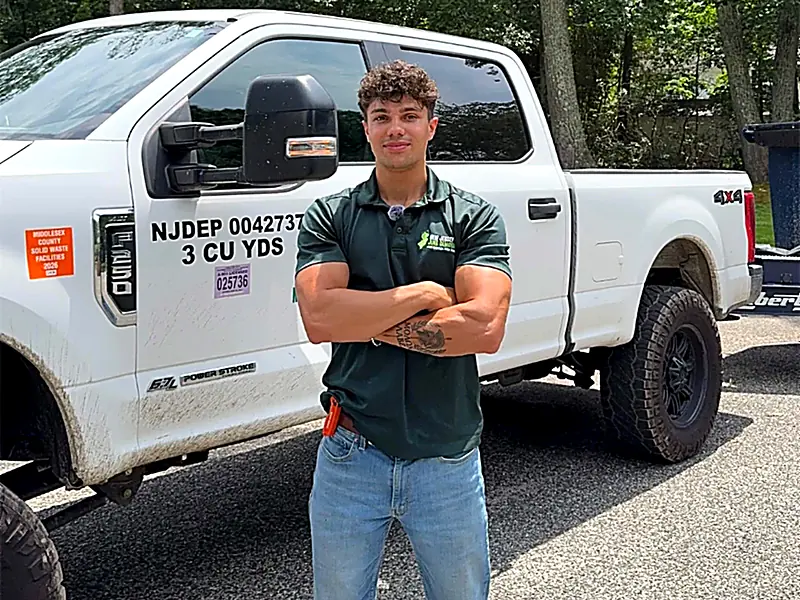
The first seven steps are family work. The heavy part can be ours. We clear whole houses, including the basement, attic, garage and shed, working around the things you're keeping, and we do all the lifting and carrying. Dominic works jobs himself alongside his crew. Items in good shape are donated when possible, metal and electronics are recycled, and the rest goes to a licensed New Jersey facility.
Text photos of each room to (855) 655-7552 for one upfront price, or book a free estimate to walk through the house together. Same-day and next-day openings are often available. More on our estate cleanout service.