The short answer: match the option to the pile
The cheapest option on paper isn't always the cheapest in practice. Count your time, the vehicle, the help you'd need, and what happens to the items your town or the dump turns away. Here's when each option makes sense:
- Town bulk pickup: a few pieces, and you can wait for the date. It's often included for residents, but every town limits how much, how often or what kind.
- Driving it to a drop-off yourself: you own a pickup or trailer and have a second set of hands. Town sites are for residents; county sites charge by weight, and private transfer stations by weight or by the load.
- Renting a dumpster: a renovation or cleanout you're doing yourself over several days, with a driveway to park it on.
- Hiring junk removal: heavy items, stairs, a deadline, a whole house, items your town refuses, or a shed, deck or hot tub that has to come down first.
First, sell or give away what's still usable
This is the one option that costs nothing, and it can even pay you. The NJDEP's own advice is to try donating or selling unwanted items instead of throwing them out. Its list of reuse options includes Habitat for Humanity ReStores for gently used furniture, appliances and building materials, Goodwill and the Salvation Army for household items, Freecycle for free local giveaways, and consignment shops that sell items for you.
The trade-off is time: listings, no-shows and pickups on someone else's schedule. Set those items aside and arrange the drop-off or pickup yourself before cleanout day. Everything that leaves this way makes every other option on this page smaller.
Town bulk pickup: cheapest, with limits
If your town collects bulky waste at the curb or runs a resident drop-off, that's usually the lowest-cost way to get rid of a few pieces. The catch is the rules. Every program caps the load, and most refuse the exact things that make a cleanout hard: construction debris, concrete, tires, electronics and appliances. For a single couch, see our couch and furniture guide. A few examples from town pages:
- Howell calls its bulk waste program free. Residents drop bulky waste at the Township Recycling Center on Old Tavern Road with proof of residency, and curbside pickup runs in spring and fall by appointment. Contractors and commercial plates can't use it, and it refuses demolition and construction debris (sheds, decks, sheetrock, concrete), tires, paint and motor oil.
- Freehold Township runs one bulk collection in the fall, with limits on volume, weight and length. Freon appliances, electronics, building materials, construction trash, concrete and tires are excluded.
- Jackson limits the size of each pile, says the items must come from the homeowner, and excludes masonry, electronics, construction debris and paint. Its page also says bulky pickup isn't for a landlord cleaning out an entire house.
- Toms River allows one bulk collection a month by phone request, but doesn't pick up move-outs or excessive volume and suggests a private removal service for large amounts.
- Wall picks up bulk once a month with a per-pickup item limit, charges a fee for Freon units, and doesn't take electronics, wooden sheds, decking, tires, construction materials, concrete or bricks at the curb. Commercial bulk and contractors aren't allowed.
- Brick schedules bulk pickup by phone with a yearly cap per household. Its Recycling Center takes resident bulk drop-offs with a tax bill and driver's license, but no construction materials.
- Sayreville collects heavy trash three times a year by zone, with a small volume cap and no extra pickups on request. Electronics, tires, appliances and masonry aren't collected, and mattresses must be wrapped.
- Lawrence collects a few bulk items once a month, each under a set weight and small enough to fit in the truck's hopper. Metal and appliances go by appointment.
- Ewing lists no curbside bulk pickup on its bulk waste page. Residents use a seasonal drop-off on Scotch Road with a purchased bulk waste pass and photo ID, and contractors and commercial plates aren't allowed.
Driving it to a county or transfer site yourself
For a truckload, hauling it in yourself is the next cheapest route if you already have the vehicle and the help. You load it, cover it, drive it, cross the scale and unload it. County sites charge by weight, so heavy material costs more than its size suggests, and anything the site refuses rides home with you.
One rule catches people out. Monmouth County's Reclamation Center prohibits rental vehicles and commercial plates for residents, and Burlington County's complex says not to rent a vehicle of any size, because it won't be let in. Renting a truck for the day doesn't work at either one.
- Monmouth County: the Reclamation Center in Tinton Falls charges by weight on its vehicle scales. Open loads must be tarped or covered, and it refuses liquids, hazardous materials, large metal appliances, concrete and batteries.
- Burlington County: the Resource Recovery Complex on Burlington-Columbus Road charges bulky waste and household trash by the ton, and every customer fills out a Waste Origin and Disposal Form. Everyone checks in at the scale house first, and the convenience center is for small truck or car loads unloaded by hand. Unless you're bringing waste from your own home in a passenger vehicle, the vehicle needs an NJDEP solid waste hauling decal. Non-freon scrap metal is taken at no charge, while freon appliances, tires and mattresses carry per-item fees.
- Ocean County: the county lists the Ocean County Landfill on Route 70 in Manchester for bulky trash. It's privately owned and run, not part of the county's solid waste department, and the county page lists no fees for it. Jackson and Toms River both point residents there for construction debris beyond what the town takes. Call before you go.
- Middlesex County: the county landfill in East Brunswick is open only to licensed solid waste haulers. The county tells residents to call their public works department, hire a licensed hauler, or use a private transfer station that takes personal vehicles, which charges per load. Call the facility first. That covers Old Bridge, Monroe, East Brunswick and the rest of the county.
- Mercer County: start with your own town's program, like the Lawrence and Ewing rules above. The MCIA transfer station in Ewing runs on prepaid accounts; see our construction debris guide.
Renting a dumpster
A dumpster makes sense for a project you're doing yourself over several days, like a renovation or a cleanout spread across a few weekends, when there's a driveway to park it on. Jackson's own page says its transfer station isn't for emptying a home and tells residents to hire a dumpster from a company for that. Before you rent, weigh what you're signing up for:
- You do all the loading. Every couch, dresser and box goes up and over the side by hand.
- It sits for days. The container takes up the driveway until the company picks it up.
- The street needs a permit. New Jersey law requires written consent from whoever controls the road, and yellow reflective markers on any roll-off left on a street. In Florence, that means a free township permit approved by the Chief of Police, applied for ahead of delivery, and the dumpster can go on the street only when no driveway or other approved off-street spot is available. Other towns run their own permit process, so ask yours; our dumpster vs junk removal guide covers permit rules town by town.
- Heavy items still need hands. A piano, a basement freezer or a hot tub doesn't get easier because the container is close.
- Some things can't go in it at all (next section). Get a written quote that says what's included and what the company refuses.
What can't go in a dumpster or the trash in NJ
New Jersey law bans throwing away desktop and laptop computers, computer monitors, desktop printers, fax machines and TVs sold to consumers, and the NJDEP counts tablets too. Collection sites run under a manufacturer's plan aren't allowed to charge consumers, and there are home pick-up programs for very heavy devices and large TVs.
Anything that can't be landfilled shouldn't go in a dumpster either. Burlington County's complex lists metal appliances, tires, TVs and computers among items that can't be landfilled there. Hazardous waste, like oil-based paint, solvents, chemicals, gas cans, motor oil, propane tanks and asbestos, stays out of any dumpster or junk truck, though we'll take latex paint once it has dried out in the can. Our guide to what junk removal can't take in NJ shows where each one goes, our refrigerator and appliance disposal guide covers fridges and freezers, mattresses have their own rules in our guides for Monmouth, Ocean, Mercer, Burlington and Middlesex counties, and our paint, propane, tire and electronics guide lists free county drop-offs.
Hiring a junk removal crew
This is the option where someone else does the work. A crew carries everything out from wherever it sits, loads it and takes each kind of material to the right place. It costs more than a curb pickup, but it can come out ahead once you count a whole house, heavy pieces on stairs, a closing date, items your town refuses, or a structure that has to come down first.
Check the license. In New Jersey, anyone hauling other people's waste needs NJDEP A-901 licensing, as Monmouth County's Reclamation Center rules spell out, and Burlington County lists junk removal and clean-out companies among A-901 licensed transporters. Ask any company for its number.
Ask what the price covers: the labor, the truck, disposal fees, and whether anything is added at the end.
When it's easier to have us haul it
If the pile is bigger than your town allows, you don't own a truck, or the heavy pieces are in the basement, text photos to (855) 655-7552. You'll get one upfront price for the whole job that includes the labor, the truck, hauling and disposal fees, with nothing added at the end. Jobs have a $250 minimum.
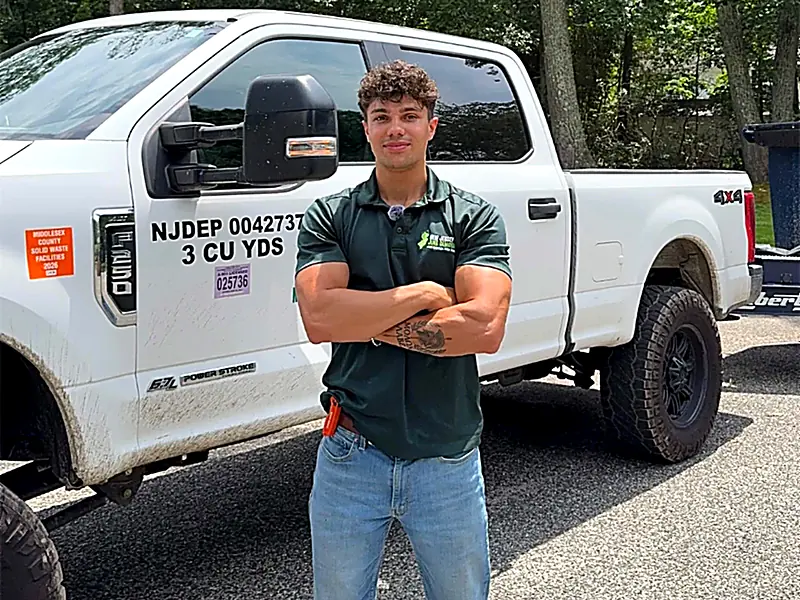
Dominic and his crew carry everything out from wherever it sits, take down sheds, decks, hot tubs, above-ground pools and playsets, and sweep up before they leave. New Jersey Junk Removal holds A-901 license #0042737, and nothing on our truck is donated: scrap metal is recycled when possible, tires, electronics and concrete go to licensed recyclers, and the rest goes to licensed transfer stations and landfills. Same-day and next-day openings are often available across Monmouth, Ocean, Burlington, Mercer and Middlesex counties. Latex paint that's dried solid can go too; what we can't take is wet or oil-based paint, chemicals, gas cans, motor oil, propane tanks, asbestos or medical waste.
For a whole house, start with estate cleanouts and our estate cleanout checklist. We also handle garage cleanouts, basement cleanouts, furniture removal, appliance removal, rental and eviction cleanouts, hoarding cleanouts and construction debris removal. Rather meet in person first? Book a free estimate.
Services for this job
- Estate Cleanouts
- Garage Cleanouts
- Basement Cleanouts
- Furniture Removal
- Rental, Eviction & Foreclosure Cleanouts