Why a hot tub is harder to get rid of than it looks
A portable hot tub is an acrylic or fiberglass shell inside a wood or synthetic cabinet, packed with foam insulation and plumbing, with a pump, heater and control box tucked underneath. It's heavy, awkward and built from materials that don't come apart cleanly.
It's also far bigger than curbside bulk programs are built for. Freehold Township's yearly bulk collection excludes anything over 200 pounds, along with building materials. In Plumsted Township (New Egypt), the MUA's bulk guidelines cap each item at 4 feet by 4 feet by 4 feet and don't take large pieces of metal. Check your own town's rules before you count on the curb.
Step 1: Shut off and disconnect the power
Small plug-in tubs just unplug from an outlet. Larger tubs are usually hardwired to a dedicated circuit with a disconnect box nearby.
Turn the breaker off first. Then have a licensed electrician disconnect the tub and make the leftover wiring safe, and ask whether your town wants a permit for that work. We don't do electrical work, so this has to be done before removal day.
If the tub sits on a deck with its own lights or outlets, have the electrician handle those on the same visit.
Step 2: Drain it and deal with the spa chemicals
Empty it fully at least a day before removal day. Leftover water in the footwell is heavy, and it pours out the moment the shell is cut. Ask your town where drained water can go before you run a hose toward the street or a storm drain.
Leftover chlorine, bromine, pH adjusters and spa cleaners are household hazardous waste. They don't belong in the trash, at the curb or on a junk truck. Every county we serve runs a program for residents. Check its current schedule and accepted-items list before you go:
- Monmouth: the county's household hazardous waste facility on Shafto Road in Tinton Falls takes drop-offs from residents with proof of residency, no appointment needed. Its accepted list includes household cleaners and muriatic acid.
- Ocean: the county's collection days require registration and proof of residency, and pool chemicals are on the accepted list.
- Burlington: the facility at the Resource Recovery Complex on Burlington-Columbus Road lists pool chemicals among the household hazardous waste it takes from residents, with proof of residency.
- Mercer: the Mercer County Improvement Authority holds three household hazardous waste events a year for county residents at the Dempster Fire Training Center in Lawrenceville.
- Middlesex: the county's household hazardous waste drop-off events list pool chemicals. Keep products in their original containers, with nothing over 10 gallons.
Step 3: Take it apart, or don't
A tub can leave in one piece when there's a wide, level path to the driveway and enough people to tip it on edge and roll it out on a dolly. Many can't. Tubs perched on a raised deck, boxed in behind a fence gate or tucked at the back of a narrow side yard get cut into sections where they sit.
Cutting one up is loud, messy work. The cabinet panels come off first, then the shell and frame get cut, usually with a reciprocating saw, into pieces two people can carry. Expect foam insulation everywhere and sharp fiberglass edges. Wear eye protection, gloves and a dust mask, and keep kids and pets well back.
Don't forget the extras. The cover, steps and cover lifter need to go somewhere too, so include them in your photos and ask whether they're part of the job.
Step 4: Where the pieces end up
Hauling it yourself takes a pickup or trailer, a tarp and a facility that will accept it. Middlesex County's advice for bulky items works anywhere: ask public works first, then use a licensed hauler or a private transfer station.
In Monmouth County, the Reclamation Center in Tinton Falls accepts waste generated in Monmouth County only. It prohibits liquids and hazardous materials and wants a tarp or cover on every open load. Residents hauling their own waste in a vehicle registered at 9,000 pounds or less don't need a dumping permit.
In Ocean County, the county lists the Ocean County Landfill on Route 70 in Manchester for bulky trash. It's privately owned and operated, not run by the county.
When we haul a tub, metal is recycled whenever possible and the rest goes to the licensed facility for the county the job is in: the Monmouth County Reclamation Center, the Ocean County Landfill, the Burlington County Resource Recovery Complex, or Duck Island in Hamilton for Mercer and Middlesex jobs.
Built-in tubs, pads and decks
This guide covers portable tubs that sit on a patio, pad or deck. A sunken or built-in spa is a different kind of job. Text photos and you'll hear straight whether it's one we take on.
The concrete pad under a tub is a separate question too. If you want it gone, show it in your photos and ask before the job is priced.
If the deck around the tub is coming out as well, both can go in one visit. See deck removal for how we take decks down.
When it's easier to have us haul it
Rather skip the saw, the dust and the dump run? The job is ours once the tub is disconnected and drained. Text photos of the tub and the path to the driveway to (855) 655-7552 for one upfront price. It covers taking the tub apart, carrying, loading, hauling, disposal and the sweep-up.
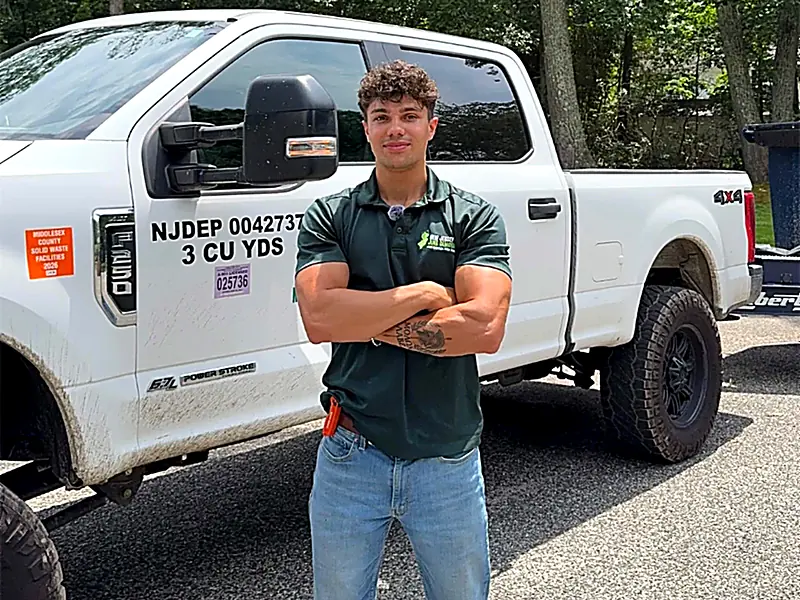
Dominic works jobs himself alongside his crew, and same-day and next-day openings are often available. We're an NJ A-901 licensed hauler (NJDEP #0042737), insured and based in New Egypt, and we remove tubs from Freehold and Howell to Hamilton and Bordentown. More on how it works: hot tub removal. Or book a free estimate to have someone look first.