Start with your town's construction office
New Jersey's Uniform Construction Code generally requires a permit from the construction official before a structure is demolished. The code also carves out small garden-type sheds: no construction permit for building work is required for a shed of 200 square feet or less and 10 feet or less in height, with no water, gas, oil or sewer connection. Electrical work still needs its own permit when it applies.
How that applies to taking down your shed is your construction office's call, so phone them before you book anything. Have the shed's rough size handy, and mention any power or water to it.
If a demolition permit is needed, the state code lists steps that come before it's issued, including releases from any utility that served the structure and confirmation that any asbestos has been or will be handled properly. Build that time into your plans.
Disconnect power and water first
A shed with lights, outlets or a small subpanel needs a licensed electrician to disconnect it and make the feed safe. A water line to a sink or hose bib should be shut off and capped. We don't do electrical work, so both need to be finished before removal day.
Empty it, and set aside what we can't take
Pull out everything you're keeping. The rest can stay put: old tools, bikes, boxes and scrap lumber go out with the shed.
Sheds also collect things that can't ride on a junk truck: gas cans, motor oil, paint, pesticides, pool chemicals and propane tanks. Those go to your county's household hazardous waste program. Check the current schedule and accepted list before you load the car:
- Monmouth: the county facility in Tinton Falls takes gasoline in a certified gas can, motor oil, pesticides and oil-based paint from residents, with no appointment.
- Ocean: the county's collection days take gasoline, herbicides, pesticides and propane tanks from residents who register ahead.
- Burlington: the facility at the Resource Recovery Complex takes residents' corrosive, toxic, ignitable or reactive products. Rental trucks and trailers aren't allowed for these drop-offs.
- Mercer: the Improvement Authority's resident events in Lawrenceville take gasoline, propane tanks, pesticides and oil-based paint, but not latex paint.
- Middlesex: the county holds household hazardous waste drop-off events, plus separate paint drop-off days for latex and oil-based paint.
Old shingles, siding and treated wood
Look at the roof and siding before anyone swings a hammer. The EPA lists roofing and siding shingles among the building materials that may contain asbestos, and says you generally can't tell by looking. If you suspect it, leave it alone and have a trained, accredited asbestos professional check it first. We can't remove asbestos.
Older pressure-treated lumber is the other thing to know about. The EPA says wood treated with chromated copper arsenate (CCA) was used in residential structures like decks and playsets before 2004, and that CCA or any other preservative-treated wood shouldn't be burned at home. CCA-treated wood shouldn't be reused as mulch either.
Burning the old shed is off the table anyway. NJDEP says open burning of refuse is prohibited under New Jersey's air pollution rules.
Why the curb usually won't take it
Once a shed is down, it's construction and demolition waste. New Jersey's solid waste rules define that as waste building material and rubble from construction, remodeling, repair and demolition, including wood scrap and metal. Town bulk programs are built for household items like furniture, so many limit it or refuse it. Check your town's rules before you start cutting. A few examples:
- Wall picks up metal sheds at the curb, but not wooden sheds or decking.
- Howell runs a free bulk drop-off at its Recycling Center, but the center turns away demolition material, and its list names sheds, decks, lumber, shingles, concrete and brick.
- In Plumsted Township (New Egypt), residents hire their own trash service. On the Plumsted MUA's contract, construction material goes out only in containers of 50 pounds or less, up to 100 pounds per collection, and wood has to be cut under four feet with nails pulled or bent flat.
- Jackson keeps construction debris off the curb, but each household can get two free construction debris vouchers a year from the Department of Public Works, with proof of residency.
Where the pieces go
Hauling it yourself? Monmouth residents can take their own loads to the Reclamation Center in Tinton Falls, which accepts Monmouth waste only and wants every open load tarped. Ocean County lists Class B recyclers for concrete and brick, and the Ocean County Landfill in Manchester for bulky trash.
On our jobs, the wood, shingles and the rest of the structure go to the licensed facility for the shed's county: the Monmouth County Reclamation Center, the Ocean County Landfill, the Burlington County Resource Recovery Complex, or Duck Island in Hamilton for Mercer and Middlesex. Metal goes to a local scrap yard to be recycled.
The base is its own decision. Sheds sit on concrete pads, blocks, gravel or wood skids, and the Monmouth County Reclamation Center doesn't take concrete. Concrete, block and brick go to a licensed recycler such as Mazza Recycling in Tinton Falls, which crushes them into fill and drainage stone. If you want the base gone, show it in your photos and ask, so you know before the job what's included.
When it's easier to have us haul it
If the shed is more than a weekend with a pry bar and a borrowed truck, text photos of the outside, the inside and the path to the driveway to (855) 655-7552. You'll get one upfront price for taking it down, hauling every piece and the contents, and sweeping up.
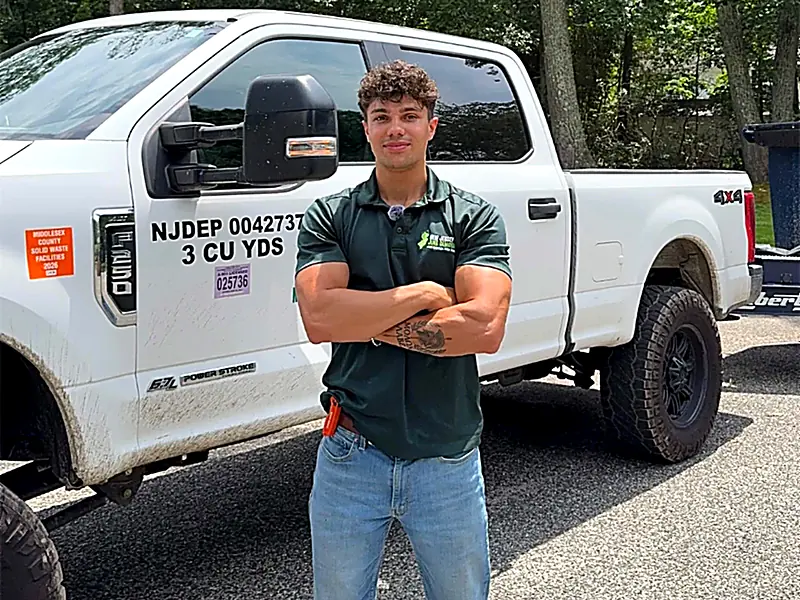
Dominic works jobs himself alongside his crew. Once any permit and electrical work is done, same-day and next-day openings are often available, from Millstone and Allentown to Cream Ridge and Chesterfield. See shed removal for how we work, and deck removal or playset removal if more is coming down. Rather have someone look first? Book a free estimate.